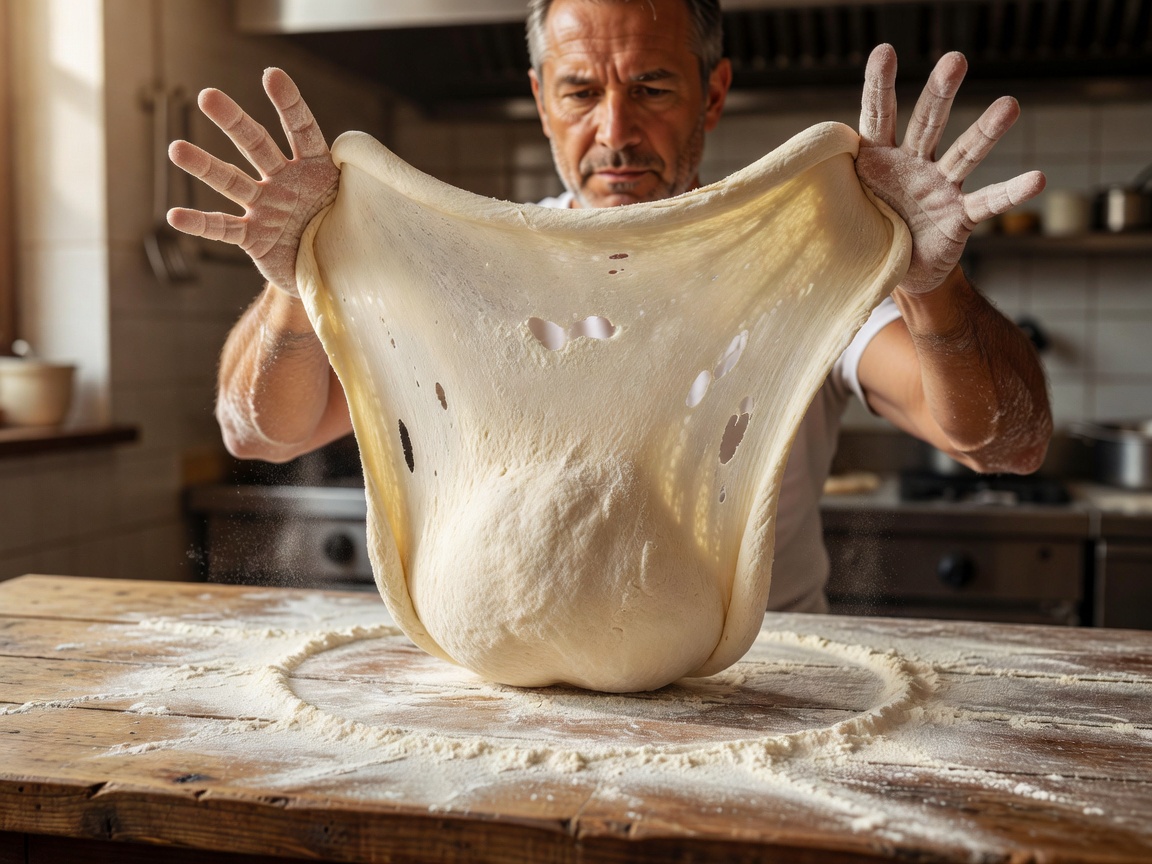
In authentic pizza making, hydration isn't simply a numerical ratio—it is the governing dynamic of gluten strength, oven spring, gelatinization, and final crust extensibility. Water acts as the enzymatic solvent that activates glutenin and gliadin proteins, forming the elastic mesh capable of trapping carbon dioxide produced during yeast metabolism.
Understanding Baker's Percentages
Every ingredient in a professional dough formula is measured relative to total flour weight, which is always established as 100%. If you use 1,000 grams of Tipo 00 flour and 650 grams of water, your hydration level is exactly 65%.
Hydration Level Comparison Matrix
| Hydration % | Crust Characteristics | Recommended Oven Temp | Handling Difficulty |
|---|---|---|---|
| 55% - 60% | Crisp, dense, tight crumb structure. Traditional New York style or Roman pan. | 500°F - 600°F (Electric/Gas) | Very Low (Ideal for beginners) |
| 62% - 68% | Classic Neapolitan balance. Soft interior, light leopard spotting, structural integrity. | 850°F - 950°F (Wood/Gas) | Moderate (Standard pizzaiolo level) |
| 70% - 75% | "Canotto" style. Extremely high puffed cornicione, open honeycomb crumb structure. | 800°F - 900°F (High Heat) | High (Requires delicate handling) |
| 80%+ | Pizza in Teglia / Roman Pizza al Taglio. Super airy, focaccia-like crumb texture. | 550°F - 650°F (Oven with Pan) | Expert (Requires coil folding) |
Flour Strength: The W-Rating Factor
High hydration doughs require flour capable of absorbing liquid without dissolving into a sticky soup. Italian flours are graded using the W-index, which measures dough strength using an alveograph:
- W220 - W260: Low-strength flour suited for 8-12 hour fast room-temperature fermentations at 60% hydration.
- W280 - W320: Medium-high strength (e.g., Caputo Pizzeria). Optimal for 24-48 hour cold fermentation at 65-68% hydration.
- W350+: Ultra-strong flour (e.g., Caputo Manitoba). Essential for 48-72+ hour cold fermentations and 75%+ hydration levels.
Fermentation Kinetics: Room Temp vs. Cold Fermentation
During cold fermentation (CT) at 4°C (39°F), yeast activity slows down dramatically, allowing proteolysis and enzymatic breakdown to occur over 24 to 72 hours. Amylase enzymes break down complex starches into simple sugars, enhancing crust browning via the Maillard reaction without burning the crust.